
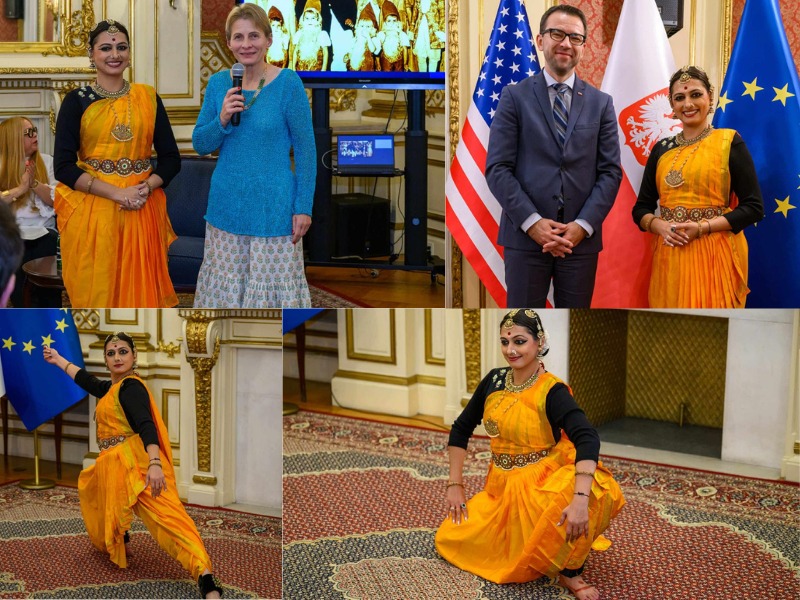
The Consulate General of the Republic of Poland in New York, together with the Józef Piłsudski Institute of America, held an inspiring and highly poignant panel “Creating a Safe Haven for Children Escaping War and Persecution – From the Polish Children of the Good Maharaja to the Children of Ukraine.”
The evening featured Monika Kowaleczko-Szumowska, an acclaimed author, scriptwriter, and producer hailing from Poland, alongside Apeksha Niranjan, a Bharatanatyam dancer, choreographer, and granddaughter of Polish refugee, Wanda Nowicka. Together, they have been sharing this unique, lesser-known part of Polish–Indian history with audiences across the globe, and their arrival in New York was a valuable moment for cultural and historical contemplation.
Mateusz Sakowicz, The Consul General of the Republic of Poland in New York, officially opened the event with a very robust, thoughtful atmosphere. Kowaleczko-Szumowska provided riveting storytelling when she spoke on the forced deportations of Polish families to labor camps in Siberia and the incredible and resilient journey of nearly one thousand Polish children who were welcomed and nurtured in pre-independent India by the humanitarian efforts of the “Good Maharaja”. Drawing from her own research and many published works, Kowaleczko-Szumowska shed light on the depth of this shared history, and the burden of survivors and their descendants that this history carries.
At the end of the evening, Apeksha Niranjan added an impactful artistic dimension with an evocative Bharatanatyam performance that was inspired by her grandmother Wanda Nowicka’s own experiences of being displaced but moving forward with resilience. Her dance combined an Indian classical vocabulary with narrative storytelling to offer a deeply personal homage to the Polish children who also lost everything in the war yet rebuilt their lives on Indian soil. Apeksha’s performance resonated with the audience, symbolically bridging the two cultures.
The panel also featured:
Imogene Salva – Author of One Star Away, chronicling her mother Ziuta Nowicka’s wartime childhood
Alexandra Hernandez – Bilingual special education teacher and trauma-informed educator
Elsa Nunez – Bilingual educator and advocate for multilingual learners
The speakers, collectively, connected historical memory to contemporary realities in a way that took special care to acknowledge the trauma of Ukrainian children who are experiencing displacement due to war. Together, they stressed the importance of creating safe, caring, and trauma-informed spaces for young survivors across generations.
The gathering included individuals from the Polish and Indian diasporas, historians, educators, and community leaders—demonstrating that the relevance of this shared legacy is still alive and that art, storytelling, and education can heal collective wounds.